When we planned this trip, our first outing of the year, little did we think that it would be our last for a very long while, possibly for the remainder of the year? We actually cut our visit by two days leaving on the Thursday ferry and not Saturday as originally planned. Following our return we have cancelled our short stay at Arbroath and this years four-week stay on Shetland. We had no trouble at all getting our money reimbursed from the ever-efficient North Link Ferries. Since then many travel restrictions have been put in place and all caravan/motorhome sites have been closed all very understandable but still sad.
Arran is a great place to visit anytime of the year, but, there’s always a but, in March with the prospect of bad weather the ferry, that’s transports folk from Ardrossen to Brodick and visa versa is in a sad technical state and could not be used in high winds due to technical problems including the mooring equipment which thankfully was repaired before we left the island. But it’s obvious that problems will continue until the long awaited new ferry is commissioned.
Our first stop over was Bridgend Cottage Camp Site for four nights. This was our favourite site from our previous visit in September last year. Normally we try and avoid returning to a site that we had previously visited but as we regarded this stop so highly, and it was an area of Arran we particularly enjoyed. The high standards set by the owners Robin and Christine last year were just as good on our return. Reasonable site fees, the friendly nature of the owners and the spotless facilities is the reason I would recommend this site to others.
 |
| Beautiful Views from Bridgend Site. |
We were the only visitors to this site, and therefore had it to ourselves for our complete stay. As with other businesses the virus was affecting the campsites booking, with people cancelling and little in the way of advance bookings which you will gather from my initial comments would become far worse.
 |
| Brodick and the Ferry. |
The following morning the weather was not too great so we decided to get the 322 bus that stops outside the cottages and go into Arrans main town Brodick. The town was, as you imagine quite familiar because of last years visit. Little Rock Cafe for hot chocoholic and scones was the prelude to shopping in Arran Active the islands specialist outdoor shop were we enjoyed the benefits of lower prices due to a seasonal sale. Strong winds and rain accompanied the bus journey during our return to site.
 |
| View from Cnoc Ballygown. |
Thick frost and ice greeted us the next morning but so did a clear sky and sunshine. So we decided a walk up 686ft to the summit of Cnoc Ballygown to see what was left of the Iron Age Ballygown Fort.
 |
| What Fort? |
 |
| Grand place to sit and enjoy the view. |
As you can see from the photo very little in fact does remains of the fort but the views were well worth the strenuous climb. Gaining some shelter from the ever-constant wind this view was a bonus as we enjoyed our lunchtime piece.
Back down via some very pleasant pastoral farmland and back into Shiskine to see the beautiful St Molios Parish Church. Known as the Red Church it was opened for worship on the 21st July 1889 and has been extended and improved ever since. And I kid you not, not one-drop rain fell all day.
 |
| The Doon. |
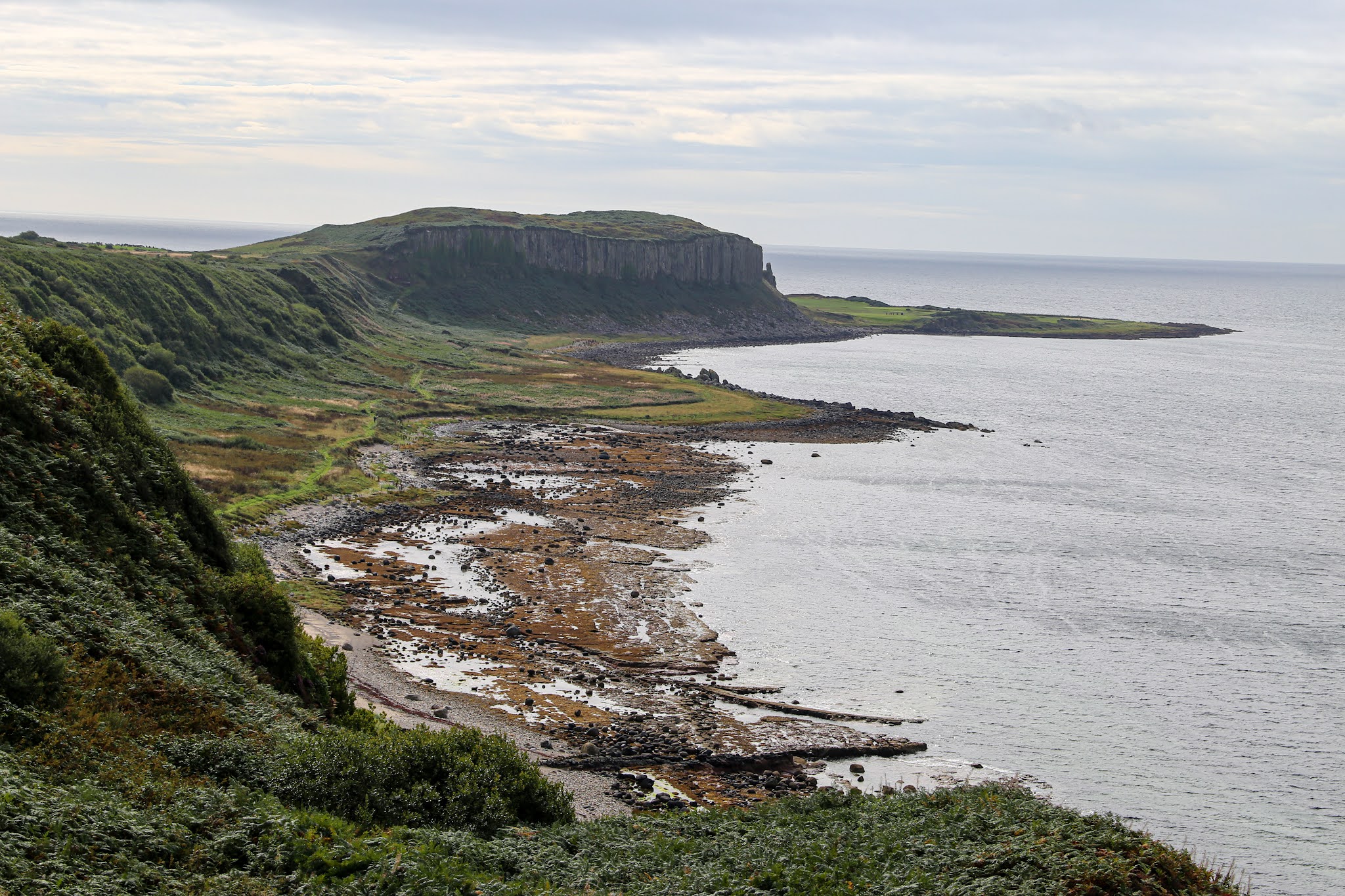
Normal service resumed the following day, damp, overcast and heavy rain. Still nothing daunts the Old Age Travellers, as well you know. The 322 arrived at 11:15 outside the camp and transported us the five miles to Blackwaterfoot, a settlement on the west coast of Arran lying on the Drumadoon Bay at the foot of the Black Water. It has a couple of shops, one of which incorporates a post office and there’s a rather nice wee cafe. As it had not started to rain we took to the shoreline passed the golf course up to the Drumadoon Point and then across the headland to the foot of The Doon and circumnavigated its inland perimeter. On the 12 acre hilltop area about 2000 years ago stood another Iron Age Fort and again very little can be seen of its structure.
 |
| Blackwaterfoot. |
Walking back via the golf course and then the shore we arrived early for our bus and as it was raining and blowing a hoolie and the bus shelter offered very little protection from the weather we decided to seek shelter and sustenance in the large and imposing Best Western Hotel for a very expensive hot chocolate and coffee - Still it passed the time until our bus arrived.
Sadly the following morning our four nights stay at Bridgend came to an end. Travelling via Brodick to replenish our supplies and some very tasty Fish and Chips at the Little Rock Cafe we continued down to the south east coast and on to Kildonan.
Kildonan settlement is 3 miles south of Whiting Bay and is said to be associated with the Irish monk Saint Donan who, coincidently my guidebook informs me, was trained at Whithorn. It was this part of the island that we did not visit on our previous visit. Initially we intended to stay at the Seal Shore Camp Site for six nights but this, as I have previously said was shortened by two days because of the worsening of the measures to control the virus outbreak.
 |
| Seal Shore Camp Site. |
 |
| Pladda with its Stevenson Lighthouse. |
Seal Shore Site is wonderfully placed right on the shoreline opposite the island of Pladda whose name comes from the Norse for “Flat Isle”. The lighthouse on the island was built by Thomas Stevenson in 1790 and was manned until the 1980’s when it was automated. Beyond Pladda can be seen Ailsa Craig rising majestically from the sea. The pitches are well organised and set out so you can enjoy the splendid views. But I afraid that the facilities are not up to standard. Toilets and shower rooms are very cold and dreary and therefore not very welcoming.
On the campsite opposite the reception is a large aircraft propeller. This is believed to have recovered by divers from a Grumman Wildcat aircraft jettisoned over the side of a US Navy aircraft carrier following the Second World War.
A short walk along the beach from our new campsite are found the ruins of Kildonan Castle built in the 13th century by the MacDonald’s, the Lords of the Isles. The Kings of Scotland, including Robert the 3rd, when the island belonged to the crown, used it as a hunting lodge. The castle became the property of the Earls of Arran but is now privately owned.
The wind abated the following morning allowing us to finally get the bikes off the back of the motorhome. After 2.5 mile ride west along the coast road and up a ‘step hill’ you come to the T-junction with the A841 and a car park where we secured the bikes. From here you continue across the main road and then follow the well-made path up to a viewing platform where the Eas Mor Waterfall drops 30m down into the rock basin of the Auchenhew Glen.
One mile north of the waterfall is Loch Garbad, which was initially along a path of conifers on one side and rolling pasture of gorse on the other but due to harvesting the conifers were not there! Owing to this on going work the pathway was very wet and muddy having been churned up by forestry machinery. Still a grand walk up to this isolated Loch where we found a bench/table to have our piece. As heavy rain started just as we finished lunch our retreat down to the shelter of the waterfall path was very swift. We were treated to heavy rain all the way back to the campsite.
 |
| The walk to Bennan Head. |
 |
| Bennan Head. |
Bennan Head can be reached by following the coastal path route west from the campsite. First part of this lovely walk is quite easy as you follow the roadway up to what used to be the Kildonan Post Office and shop. From here you can walk along the beach and a rather muddy pathway until you get to a section just before the Head where you have to scramble over boulders. As the boulders were getting quite large and possible dangerous it was here we decided to conclude our outward walk and stop for our sandwiches and coffee.
 |
| The 314m Ailsa Craig in the background. |
During this most enjoyable walk we observed common seals basking in the warm sunshine on the rocks that run out into the sea and also another fine waterfall tumbling over cliffs.
 |
| Memorial Bell. |
 |
| War Memorial. |
There were some interesting things to see on the way back including a memorial bell set in a wall and one of Scotland’s more unusual war memorials, a plaque fixed to a prominent rock standing high above the beach.
There is a very unusual house over looking the shore. Drimla Lodge is a magnificent red brick colonial style villa that was built in around 1896 for the Clark family who owned the Saxone shoe company which had factories in Brazil, a country that influenced the architectural design of this imposing house with ten sets of French windows on the ground floor with three more on the first floor.
It was that evening we made up our mind to cut the holiday short and contacted Cal-Mac the following morning, who were very understandable and booked us on a ferry the same day. A sunny and quite warm trip across the Firth of Clyde to Ardrossan finished what I suspect will be our last Motorhome trip for sometime.