Sitting opposite the garrison of Fort George, which is still in use as a
military establishment, the village of Rosemarkie is situated on the south
coast of the Black Isle peninsula. It is said to have one of the finest beaches
on the Moray Firth Coast Line and boasts the Groam House Museum that is home to
Pictish stone, found in the local area and dating back to the 8th century, also
a collection of art by the Caithness born artist George Bain. The village
itself is very quiet, has a lack of coffee shops and only a small Spar
supermarket. But the neighbouring village of Fortrose offers not only an array
of small shops including a butcher, a baker and a Co-Op but some nice coffee
shops and eating-places. Between the two villages are a couple of well-situated
campsites, both offering sea views across the Moray Firth. The site we choose
was the Rosemarkie Camping and Caravan Site whose camp staff we found both
friendly and helpful. This busy site has clean facilities but certainly nowhere
near enough of them; three showers per gender are not good enough for the 60
pitches. Between the elongated coastal site and the sea is a minor busy public
road that does not allow the campsite the privacy that most sites enjoy. Also
there is no Motorhome Service Point so grey waste has to be bucketed.

 |
| Beach in front of Caravan Site. |
 |
| Typical of the local architecture. |
 |
| Celtic Art outside the Groam House Museum |
A short walk along the shore from our base is the Fairy Glen known
locally for the ‘well-dressing ceremony’ where the children of the village
decorated a pool, next to a spring, with flowers. This was done so that the
fairies would keep the water clean. And it must have worked as the water
cascading over the two waterfalls is beautifully clear and looks good enough to
drink. This popular walk takes you up to the waterfalls via some enchanted
unspoilt woods. The walk starts from the Rosemarkie Beech Cafe and I would
suggest you return the same way so you can make use of the conveniently placed
picnic benches overlooking the shore.
 |
| The enchanted forest of the Fairy Glen. |
 |
| Theres a pool to decorate. |
 |
| At the end of your walk your rewarded with these Waterfalls. |
A must is the walk in the opposite direction via Rosemarkie Caravan and
Camping Site, passed the Golf Club, with the sea one side and the golf course
the other it's a grand evenings stroll. Eventually arriving at Chanonry Ness
Lighthouse, built by Alan Stevenson and first lit in 1846 this is said to be
one of the best vantage points to see Bottle-Nosed Dolphins in the Moray Firth.
You will need to time this right, one to two hours after the low tide is said
to be the best time to catch a glimpse as these delightful creature’s feed on
the incoming salmon.
 |
| Dolphins at Chanory Point |
North of Rosemarkie is the picturesque village of Cromarty which has an
abundance of well preserved red sandstone houses and is located on the north
eastern tip of the Black Isle. It can be reached by using a B road via Eathie
that avoids most of the heavy rain traffic that travels to Cromarty via the
main A832. This nine-mile cycle ride
takes in some very rich farmland and some grand sea views. As you descend on
the final part of the journey the Cromarty Firth comes into view, which
displays the evidence of the areas oil industry. The town itself boasts very
few shops but does have some places of interest including the 18th century
Cromarty Courthouse and two houses that celebrate the life and times of Hugh
Miller, who was born in one of them. Miller was an intriguing character who took
his own life at the age of 54. He wrote widely on geology, politics and
religion becoming a leading light in setting up the Free Church in 1843. During
his short lifetime he collected fossils and over 6000 of which are to be found
in the National Museum.

 |
| The ride to Cromarty takes in some lovely countryside. |
 |
| Cromarty. |
 |
| Lots of things to see and do. |
 |
| The oil industry. |
 |
| Hugh Millers house. |
 |
| Hugh Millers gardens. |
Although we are not in the habit of moving our Motorhome once it has
been set up sometimes interesting places to visit are not on a regular bus
route and are outside the range of our ebikes. One such place is Culloden Muir.
This was the site of the last battle to be fought on British soil. It took
place on 16th April 1746 between the Highland army of Prince Charles Edward
Stewart and the Government forces of the Duke of Cumberland. The main reason
for this bloodthirsty battle was to reclaim the thrones of Scotland, England
and Ireland for the Stuart dynasty. It is alleged that over 700 brave men of
the Jacobite army were killed in direct battle with a further 800+ wounded men
slaughtered after the battle by Cumberland, who was labelled ‘the butcher’ for
his men's cowardly actions. The aftermath of the battle accelerated the
dismantling of the Clan system and gave a foretaste of the Highland Clearances to
come when families were forced from their homes and land. The bad taste left
after this period still lingers to this day. Don't miss the opportunity to
visit this National Trust property and take advantage of a free tour of the
battlefield and learn more about Jacobite history.
 |
| The Battle-Field. |
 |
| A typical cottage. |
 |
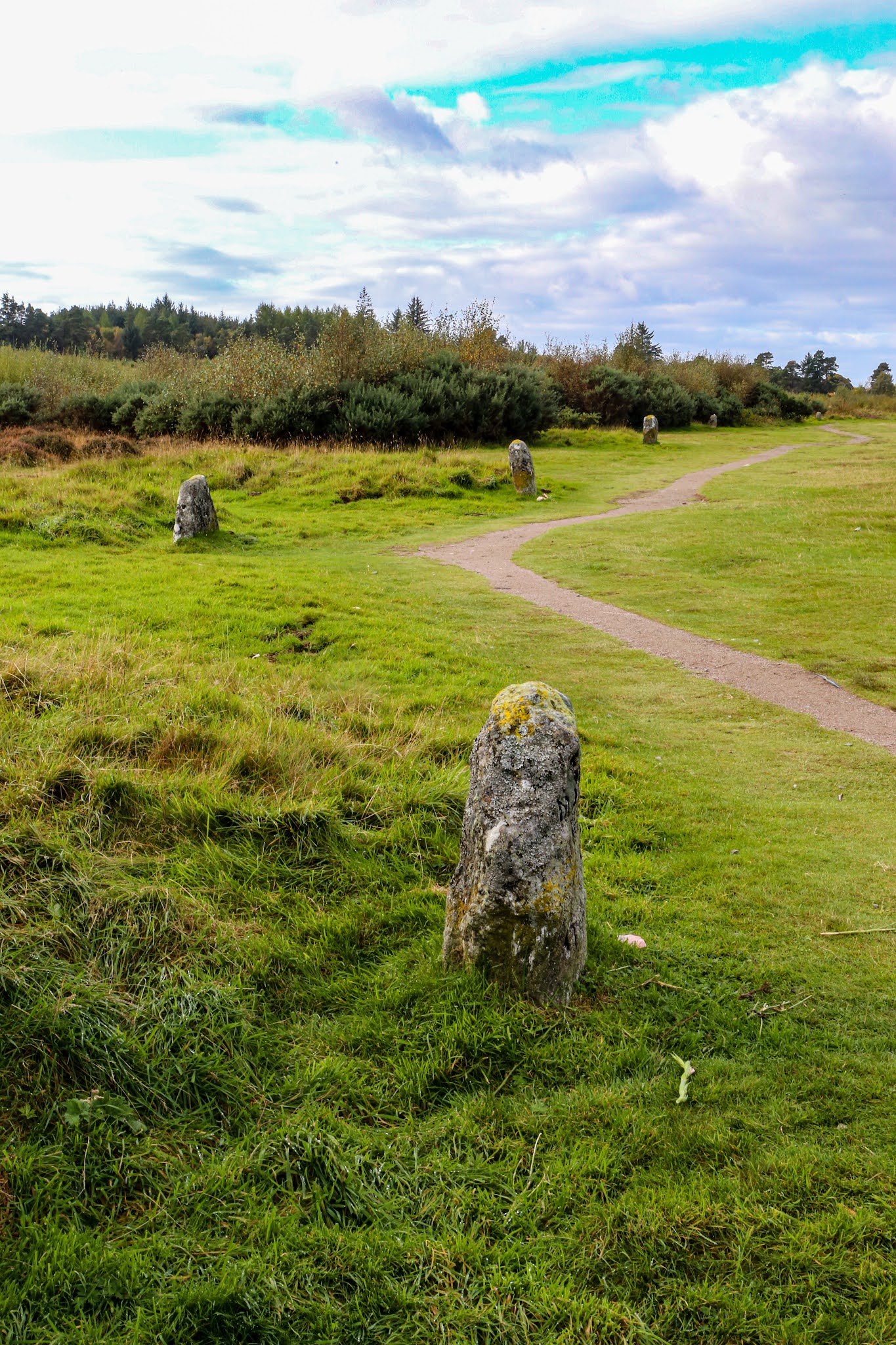
| Commemorative Stones. |
 |
| On to which people are still placing flowers. |
 |
| Wall of death. |
 |
| New Museum, cafe and reception. |
Fort George, a great white elephant, was completed in 1769 by George 2nd
government to house an army of occupation in the Highlands after the Culloden
battle to ensure that the Highland Clans and there supporters would never again
rise in support of the true heirs of the English, Scottish and Irish throne. It
was never attacked by a Jacobite army or for that matter any other invading
forces. When you visit The Fort the first thing you notice is the high standard
of the buildings that have stood the test of time. Still in use, it forms a
training base for the British Army and therefore some of the buildings are not
open to the public. This is another very interesting place to spend a day going
back into Scottish history and learn the many campaigns that the Highland
Regiments fought in. Enjoy a mile plus walk around the ramparts keeping an eye
out from the Duke of Marlborough’s Demi-bastion for the dolphins.
 |
| Fort George in all its splendour. |
 |
| Fort Georges Chapel. |
 |
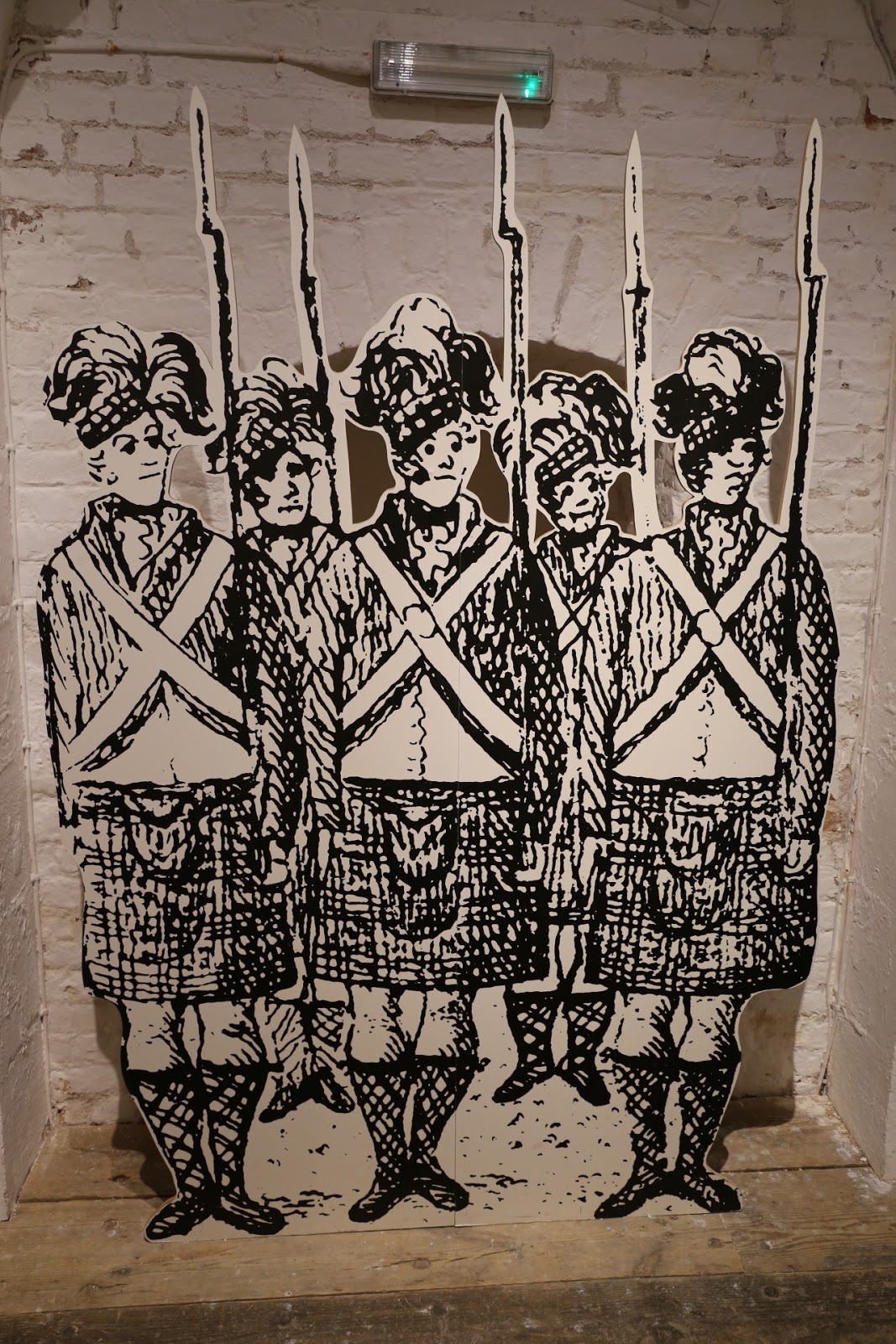
| Some of the original occupants are still there. |
 |
| Sleeping quarters. |
 |
| Protecting the Fort. |
 |
| Grand Magazine. |
 |
| The Seafield Collection of Arms. |
 |
| You've seen it here first. |
 |
| Fort George Dolphins. |
The Black Isle, neither Black nor an Isle is a beautiful and interesting
part of Scotland. Don't miss a visit to
the old fishing village of Avoch which has a harbour that was built by Thomas
Telford in 1814 or a bike ride around the local rich arable countryside using
the quiet back roads. Both the villages of Rosemarkie and Fortrose, as I have
described are grand traditional places that have not been spoilt by the large
amount of tourism.